STORY 06
Searching for It a Thousand Times
 虎头锤 (Hutouchui) · Staff Engineer
Translated from the original Chinese essay · Read the Chinese original →
This is the sixth piece (6/100) in Wandering Under Different Stars.
A cup of coffee can become espresso in twenty seconds under high heat and pressure, or it can be slowly extracted into cold drip over eight hours. Loki's path is more like the latter.
First Extraction
The lights were white, so white they flattened the temperature of the room.
On the stage at Google Search Central Live APAC in Bangkok, Loki flipped to a slide: One JS Problem Solved.
12 months, traffic grew from 100,000 to 800,000; 24 months, it broke 1.2 million.

The audience fell silent for a moment. Some people raised their phones to take photos, others murmured in amazement. For many who run websites, those numbers represent the life or death of an entire business line.
I wasn't there in person; he told me all of this. I've known him for many years, watched him struggle through one thing after another, change directions again and again, heard him laugh at himself and say he always seems to be experimenting with his life. So when he told me about this, I felt a little dazed: was this really the Loki I used to know?

First Cup: Espresso, Twenty Seconds Under Pressure
Espresso is extracted in just twenty seconds with high-pressure hot water—direct and intense. Many decisions in life are also frozen in place under pressure like this.
In 2012, he landed in Brisbane. The plane arrived at night, streetlights were sparse, and a damp wind slipped through the parking lot into his collar. The next day, he went to a fast-food restaurant to order, looked at the English menu, and felt lost. Before speaking, he could only manage an awkward but polite smile, and in the end he pointed and said, this and that. English on paper was a string of scores; English at the counter was a wall.
He is from Shanghai, so studying abroad seemed natural enough. But even though he came from a big city, he didn't really understand how to choose a major, so he picked hospitality management. He was young then, and his family supported his restless energy—he had to study, and he also wanted to pool money to open a coffee shop. He thought sheer enthusiasm would be enough to keep it going.
He chose the beans himself, practiced latte art until the early morning, redid the brewing curves over and over until his wrists ached and trembled. Customers liked what he made, but the ledger never lies—red numbers lingered line after line, refusing to leave. On the day the shop closed, there were two cartons of milk left. He carried them to the river, tore open a corner, and thought: this is clearly good milk, so why does it taste so bitter?
In his own words, "Those years I was just stubborn. I had to try it. The money I lost, I treated as tuition."
My coffee knowledge all came from him. High heat and high pressure for twenty seconds makes espresso; high heat for two minutes makes pour-over; low temperature for eight hours makes cold brew. He could explain every method in great detail. Sometimes I think his path is like these different coffee methods—high pressure, quick results, slow extraction—each yields different results, but all are worth trying.
Second Cup: Pour-Over, Two Minutes of Tension
Pour-over coffee requires controlling the water flow and angle. Those two minutes are full of tension, and the slightest mistake affects the flavor. During those years, his life was exactly that kind of tense state.
The money lost in the coffee shop had to be repaid, and to immigrate he had to switch to an IT major. He didn't want to ask his family for money again, so he went to work at the airport duty-free shop.
Night shifts paid well by the hour, but this wasn't about experiencing life—it was about paying tuition bill by bill. Every time a flight landed, crowds surged forward and the cash register beeped nonstop. He worked six days a week, so tired he could barely keep his eyes open. But the bills never showed mercy; tuition was clear and exact, and he didn't dare stop.
His English was forced out of him in that environment. Passengers had all kinds of accents. Some were in a hurry to catch a flight and would toss out a "hurry please," and he would immediately double his speed. Others would draw out their words and make a joke, and he could respond with a line or two so the moment didn't turn awkward. Slowly, he developed the ability to read people—watching their eyes, listening to their tone, even sensing their pauses.
Later he said that what that period really left him with wasn't money, but the sharpness to catch key information amid noise. It seems that along his path, the critical moments were all in situations where he was forced to adapt.
But the sense of falling behind never left him. Some of his classmates went to Microsoft, Amazon, investment banks, while he was swiping cards and making change at a counter. The trouble with smart people is that they always feel they're suited for too many things and want to try them all. The process of trying brings novelty, but it also consumes time. He would smile wryly and say: if I had settled on something a few years earlier, would I have gotten here faster? Then he would turn around and say: but without all those detours, I wouldn't have developed the sensitivity I have today.
Tasting: Flavor in the Detours
Real tasting requires waiting for the coffee to cool slightly before the layers emerge. Many detours only reveal their flavor when you look back.
When his visa was about to expire, Australia's immigration policy tightened again. Agents said there was no hope—traditional IT occupations required IELTS scores of 8 in all bands, plus age points and a professional year. And that year, the policy was unpredictable. But he dug through all kinds of information, page after page on the immigration department's website, and locked onto an obscure new occupation—Security Specialist. It had just been added, and even agents weren't familiar with it. He repeatedly compared the skills assessment criteria and started preparing the documents himself.
As it happened, when he switched majors in Brisbane, he had actually taken a security-related course. At the time he thought it was just an obscure subject, never imagining it would later become a crucial link. A choice that had seemed like a "waste" ended up opening an exit for him.
He said that for those few weeks, he worked during the day and filled out forms at night. The light was dim, and he stared at the screen until his eyes went dry. The moment he submitted, he had no confidence at all. It wasn't until the invitation letter arrived in September that he let out a long breath. That breath was mixed with the steam of a coffee machine and the exhaustion of countless late nights. The visa was granted in December, and his old visa expired in February—he slipped through the final gap and stayed.
Third Cup: Cold Brew, the Art of Time
Cold brew takes eight hours, with cold water dripping one drop every three seconds—slowly permeating, using patience and time.
During his years in Brisbane, he changed majors and changed jobs, but he always felt like he was trapped in a small pond. He could work as a programmer, and the market was decent, but something always felt missing. After a night shift, when the sky was just getting light and he walked down empty streets, a thought would surface: maybe it's time to move somewhere else?
Moving to Melbourne was another new attempt. He had relatives there, and a larger Chinese community, faster information flow, and more opportunities. As it turned out, that step was the right one.
It was in Melbourne that he first encountered SEO, and for the first time felt, "Maybe I can put down roots here." I met him in Melbourne, and together we started organizing IT communities and offline events.
One weekend, Loki and I invited Sister Jingjing (a long-time SEO expert at REA, whose team is arguably the strongest in Australia) to run an offline SEO workshop. Loki sat in the audience, looking at the arrows on the whiteboard—from request to rendering—listening to her explain how search engines see web pages. Something clicked in his mind, like a key finally fitting into a lock.
So there was a field that required understanding code, yet was also close to people. Not just writing code, not just doing marketing, but standing at the intersection: explaining, taking apart, fixing, building bridges. After that day, his path began to clear through the fog. A few years later, Jingjing became his business partner.
I sat to the side, watching him fill several pages of notes. Looking back now, that may have been the true starting point of his career.
His energy for learning SEO was the same as when he learned coffee. He worked during the day and dismantled websites for practice at night. Many websites at first either had nothing, or felt like ready-made templates had been used, yet still no one could find them. It was like a shop with the lights on and the goods displayed, but no sign outside—people outside simply couldn't get in.
Clients always wanted shortcuts. He would nod, then shake his head and say: some places can be patched first, like the content on the landing page, but you still need to analyze keywords and create content based on them. SEO can't be rushed. He took it apart bit by bit, wrote bit by bit, accumulating slowly like cold brew.
So he wrote down his experiences—cases he had worked on, and the stumbles he had taken. Others read them, forwarded them to friends, or followed the checklists to make changes. The more he wrote, the more he was pushed to the front. Not to be a teacher, but to pry the door open a little so that those who came later could take fewer detours.
Tasting: The Sweet Aftertaste
Good coffee may taste bitter at first, but it leaves a sweet aftertaste. After all the detours, that moment on stage was sweet.
Back to Bangkok, during the Q&A session. Someone asked a question, and Loki tapped the screen and asked everyone: Are you sure your website can be seen by Google? The words hung in the air, and the room went quiet for a moment. Modern websites are full of unknowable JavaScript. What we see is not necessarily (in fact, definitely not) what the crawler sees.
When he told me about this, the image that came to my mind was different—it was the scene from that workshop years ago, when he sat in the audience writing furiously. Back then he was below the stage; now he is on it.
Walking to the end of the corridor, he ordered a coffee from the vending machine. The steam rose up, like the lingering warmth of the stage lights. He held the cup, looked out the window at the flags fluttering in the wind. His phone buzzed—a photo from his wife: the kids' ballet performance today was a great success. Yes, he also supports his wife's dance school on a regular basis. Take a look at this lovely family.

Like a cup of cold brew, eight hours in exchange for one clear, bright sip.
Searching for it a thousand times, his answer is a persistence slowly extracted over time.
Cupping: A Promising Future
Cupping is the most essential ritual in the coffee industry. Tasters use it to judge the quality of beans and predict the future of the flavor.
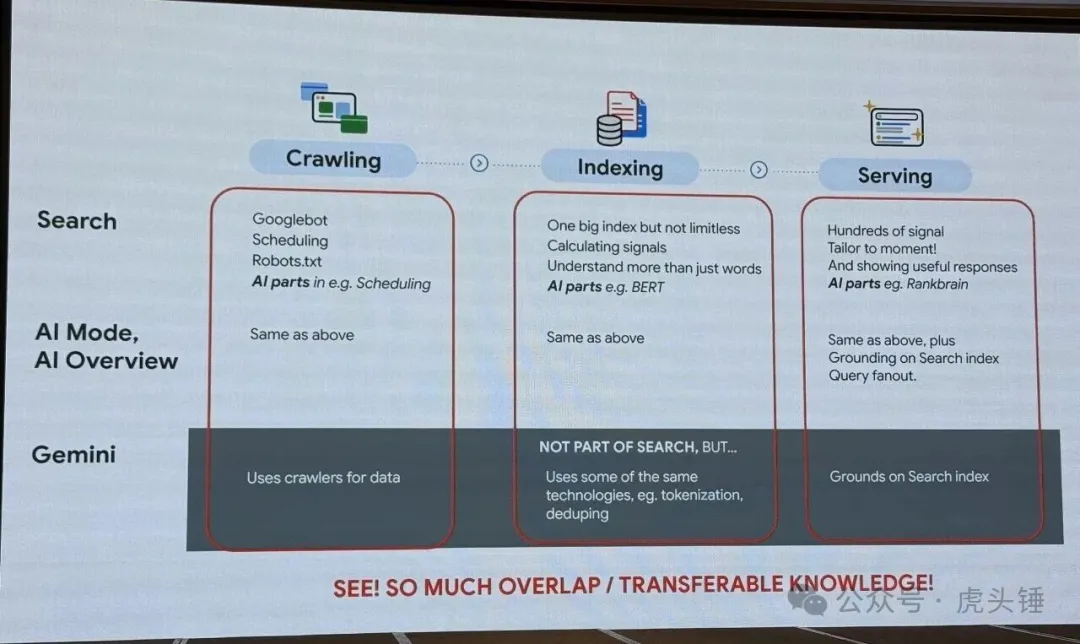
After the event, he was excited about a diagram from Google. On the screen, above the foundation of Crawling, Indexing, and Serving, lay a gray line representing the future: Gemini.
No matter how powerful AI becomes, it still has to stand on the foundation of search. Web pages must first be crawled, then placed into the index, then judged useful or not based on signals. None of these steps have changed.
In other words, SEO is not a job that will be eliminated—it will become even more important. At the very least, it can run for another ten years.
Back in Melbourne, when he searched his own name on Google, he saw another picture: in the AI-generated overview, he had already been identified as an entity. His profession, field, and speaking experience were all listed clearly. He himself had become a node recognized by the system.

In the eyes of others, that's a personal brand. In the logic of AI, that's an entity. In his own heart, it's just the traces left by one exploration after another.
To make a good cup of coffee, from grinding the beans, to distributing the grounds, setting the extraction rate, extracting, frothing the milk, sensing the temperature of the milk foam, and pouring the milk into the espresso—not a single step can go wrong.
SEO is likewise a field that demands deep attention to technical detail: every line of HTML, CSS, JavaScript, every word, every URL definition—all of it affects the final ranking of a website.
These are all his "searching for it."
"Searching for it a thousand times." He writes "it" in lowercase.
Sometimes it's a career: from someone who writes code to someone who can explain complexity clearly. Sometimes it's a direction: in Australia, taking it slow is okay. Sometimes it's meaning: bringing updated experience back to the Chinese-speaking world so that those who come later can walk a little less in the dark.
On stage and off stage, like a road quietly connected. From the bar counter to search, from a latte to a verifiable presence, from chaos to rhythm.
Searching for it a thousand times is not about finding the destination, but about learning a way of walking.
This cup of coffee is still slowly extracting.