Clarify
Clarify
Who is this for? What are we trying to change? What does success mean?
Make tacit knowledge visible
Many things remain hard to understand not because information is missing, but because the judgement behind them was never made visible.
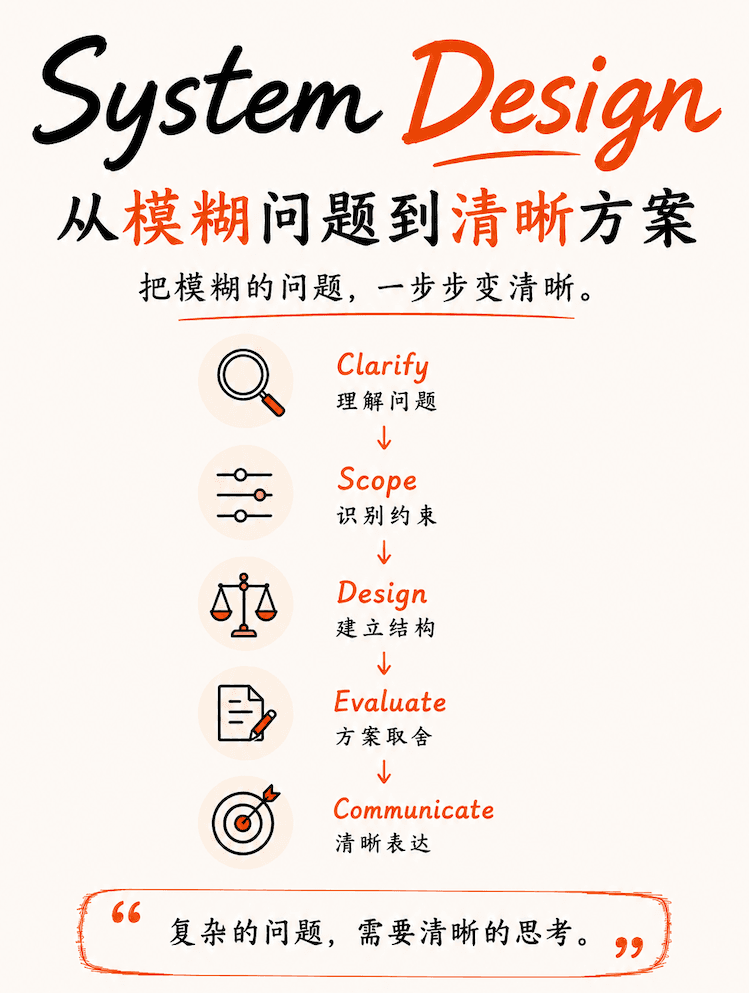
Untacit is not a rigid five-step formula. It is a way of working: clarify the problem, draw the boundary, design from real flows, judge under constraints, then communicate the reasoning clearly.
Clarify
Who is this for? What are we trying to change? What does success mean?
Scope
Where is the boundary? What is the smallest useful version? Which uncertainty matters most?
Design
How does value move through the system? Who owns each decision and each piece of data?
Evaluate
What do we gain, what do we give up, and what new evidence would change the choice?
Communicate
Can someone else follow the reasoning, challenge it and use it?
IN-PERSON · MELBOURNE
The method was not invented for a website. It grew out of working through ambiguous problems together: clarifying what matters, setting boundaries, shaping a design, making trade-offs and explaining the reasoning. Those workshop materials later grew into Untacit.ai.
System Design is not only about systems. It is about how we face complex problems.
This is not a session for memorising Redis, Kafka or a universal template. We work through a realistic case from problem framing and constraints to trade-offs and communication. It is designed for mid-level and senior engineers, tech leads, architects, system design interview candidates and technical people building AI products.